Today, as technology is increasingly integrated into life, even our pet world has begun to have a wonderful intersection with artificial intelligence. Imagine when you bring home a new robotic dog that can walk on its own and makes a simulated barking sound. How will your husky, known as the "two", react? Think of it as an enemy invading territory, or as a weird new friend who can't wag his tail? This article will take you in-depth observation and reveal the instinctive reaction of the husky when it first faced the robot dog. This is not only a simple encounter, but also a vivid test of the dog's social instincts and cognitive abilities.
Chapter 1: First encounter-Ten seconds when the air froze
When the robot dog is started, makes a slight motor running sound and begins to take the first step, the first reaction of most huskies is usually to freeze for an instant. They will freeze in place like a sculpture, their ears stand upright like radar, pointing at the source of sound and movement, and their eyes will be filled with extreme concentration and confusion. This "freezing response" is typical of dogs when encountering unknown, potential threats, or highly novel stimuli. They are rapidly mobilizing all their senses for analysis: visually, this "thing" has a canine-like outline, but its movement style appears stiff and weird; audibly, the "buzzing" motor sound and programmed barking are completely different from the heartbeat, breathing and emotional cries of real dogs; in terms of smell, it is even more problematic-it has no unique smell of life, only the cold smell of plastic, metal and electronic components.

These short ten seconds are a microcosm of the storm in the husky's inner world. Their instincts tell them to be wary of any moving objects that intrude into their territory, especially this "four unlikable". But at the same time, the husky's innate curiosity (and to a certain extent "foolish courage") began to stir again. This fierce confrontation between "cowardice" and "curiosity" is written on their rich-expressed faces: their eyebrows may be slightly wrinkled, their eyes may want to stare but cannot help but wander, and their body's center of gravity is backward, posing that they can retreat at any time. Posture, but the tip of the tail may have begun to shake slightly unconsciously, exposing their inner desire for exploration.
Chapter 2: Tentative Approach-The Limit of Cowardice and Brave
After the initial shock and assessment, the Huskies usually move to the second stage: tentative approach. This process is full of comedy effects. They don't charge straight forward like a real toy or enemy, but use an extremely circuitous and cautious strategy. You may see it starting to circle the robot dog, with the robot dog as the center, conducting a large-scale "arc walk", observing the monster's reaction from all angles. He walked carefully every step, and his claws landed gently and slowly, as if he were walking through a minefield.
More classic probing moves include "lightning touch" and "feint attack". The so-called "lightning touch" means that the husky will stretch out its claws at a very fast speed, gently pat the outer shell of the robot dog, and then bounce off instantly like an electric shock, jump back to a safe distance, and carefully observe whether the robot dog has been "activated" for a more intense reaction. The "feint attack" is more dramatic: they will suddenly lower their foreheads, raise their buttocks, and make the classic "invitation to play" or "prepare to attack" posture, which may even be accompanied by a bluff bark or two, but once the robot dog turns its head or moves in its direction, it will immediately retract its stance, take a few steps back, and return to observation mode. This kind of repeated horizontal jumping behavior perfectly interprets the essence of "being timid and playful". Their instincts warn of danger, but curiosity attracts them like a magnet to learn about this new thing.
Chapter 3: Interaction upgrades-from confusion to "social attempts"
If the robot dog's design is relatively "friendly"(such as non-threatening movements and not loud), the husky's interaction may escalate after confirming that this "thing" will not cause physical harm to him for the time being. Their curiosity began to gain the upper hand. You'll find huskies starting to experiment with some common social behaviors among dogs, even though the object is a robot.
Frustration in olfactory surveys:The main way dogs understand the world is through their noses. Huskies will be very persistent in trying to smell the "key parts" of the robot dog, such as the head (simulating the mouth and nose) and tail. However, no matter how hard it sniffs, the only feedback it gets is the smell of industrial materials. This lack of information can make them feel very confused and frustrated. You may see it tilt its head, showing a more puzzled expression, and even use its claws to rub the robot dog's "face" in an attempt to find the source of the smell.
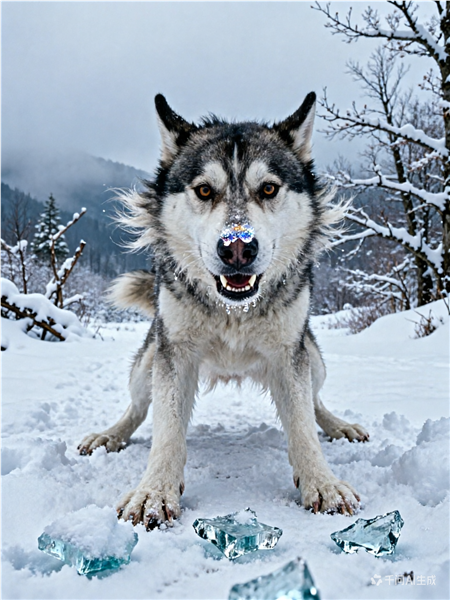
Invalid social signals:Huskies may make social gestures at robotic dogs such as wagging their tails, barking lightly, or even trying to bump their bodies lightly. However, the robotic dog's programmed response cannot give feedback that is consistent with the dog's social etiquette. For example, when the husky wags its tail in a friendly manner, the robot dog may just continue walking along the preset path or suddenly turn around. This kind of "chicken-to-duck talk" interaction sometimes makes the huskies feel boring, and sometimes it stimulates them to explore more-they want to understand what the "guy"'s behavioral rules are.
Imitation and learning? Observers have reported that some particularly smart huskies will try to imitate its movements after observing the robot dog for a while, such as following the robot dog along the same route, or responding with a similar tone when the robot dog makes a sound. This may be seen as an advanced cognitive behavior, although the motivation may still be curiosity and play.
Chapter 4: The Outbreak of Instinct-the Impulse to "Demolition" and Territorial Awareness
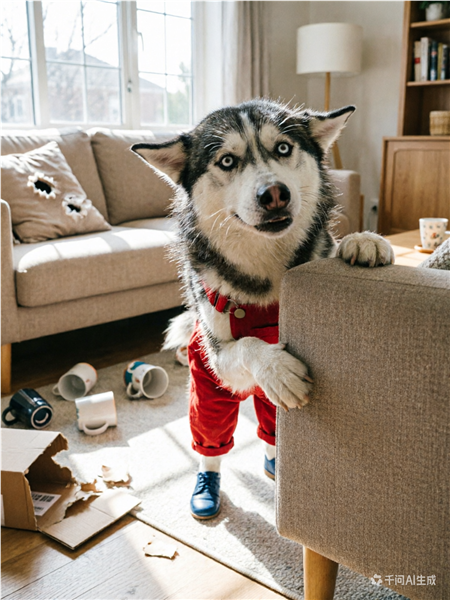
Don't forget Husky's "old job"-the director of the demolition office. When the initial fear and novelty pass, if the robot dog continues to move within its range of motion, the husky may redefine it as an "advanced mobile toy" or a "territory invader." At this time, some deeper instincts may be triggered.
Chasing instinct: Therobot dog's rapid and unpredictable movements can easily inspire the husky's chasing instinct as a sled dog. They may suddenly start chasing robot dogs, viewing it as a chase game. At this time, the state is often more relaxed than before, the tail is tilted high, and the movements are bolder.
Hunting/play sequence:After the chase, you may enter the "bite" stage. Huskies may try to hold the robot dog's "neck" or body with their mouths in an attempt to subdue it. This is a severe test for the outer shell and internal structure of the robot dog. Owners need to pay close attention to prevent expensive technology products from turning into husky's "teething sticks".
Territory marking behavior:In rare cases, if a husky views a robotic dog as an incomprehensible but persistent territorial threat, it may attempt to mark it near the robotic dog or even try to mark it with urine to declare sovereignty. This is a primitive way for dogs to deal with uncertain threats.
Chapter 5: Behavioral Interpretation-Why Reaction?
Huskies 'complex reactions to robot dogs can be explained from the perspective of animal behavior and cognitive science.
Fear of novelties and drive to explore:All animals have both basic drives for novelties: fear and inquiry. Fear is to ensure survival safety, and exploration is to obtain environmental information and find resources. As a working dog with high energy and high IQ, the husky usually has a strong drive to explore, which drives it to approach the robot dog. However, the robot dog violates many key characteristics of the "living thing" it perceives (smell, softness, response pattern), so the fear drive remains online, making it "timid and curious."
Cognitive dissonance:Robot dogs present a kind of "cognitive conflict." It looks like a dog (visual outline), partially behaves like a dog (moving, sounding), but feels not a dog at all (smell, touch, interactive feedback). This conflict makes it difficult for the husky's brain to classify it into any of the familiar categories (companions, prey, enemies, toys), leading to confusion and test-and-test behavior.
The dilemma of social animals:Huskies are highly social animals that are accustomed to communicating with their own kind through complex body language, sounds and smells. Faced with a robot dog that completely disobeys social rules, all their natural social skills have failed. This frustration is also one of the reasons for their capricious behavior.
Chapter 6: Long-term coexistence-will it become friends or "furniture"?
As the exposure time increases, the husky's response to the robot dog generally goes in two directions.

Habitualization and neglect:Most huskies will eventually "habituate" robot dogs, that is, as a harmless but boring background noise or moving furniture in the environment. Once they confirm that the "thing" does not bring food, threats, or effective social interactions, their curiosity runs out and they ignore it. As the robot dog moves around the room, the husky may not even be bothered to lift his eyelids.
Specific game partners:If the robot dog is just designed to continuously trigger the husky's desire to play (e.g., capable of simple chase-avoidance interactions and strong enough), a few huskies may view it as a special, never-tiring game prop. But this interaction is still one-way and lacks the emotional depth of true social interaction.
Potential sources of anxiety:If the robot dog moves suddenly and its voice is sharp, a few sensitive huskies may continue to feel nervous and anxious about it, viewing it as an unpredictable threat. At this time, the owner should reduce or stop this contact to protect the pet's mental health.
Chapter 7: Advice for the Owner--Observation Experiments for Safety and Fun
If you want to observe the interaction between your husky and robot dog, please follow the following principles to ensure safety and fun:
- Full supervision:Never leave them alone. Prevent Husky from damaging robot dog and also prevent robot dog from accidentally bumping into or scaring Husky.
- Control initial contact:When meeting for the first time, let the robot dog remain stationary or turned off, and let the husky familiarize himself with the "object" through smell. Then start slowly, starting from the quietest and slowest mode.
- Give the husky freedom to escape:Make sure there is enough space in the room so that the husky can always choose to stay away from the robot dog and hide in a place it deems safe (such as its own nest or next to its owner). Don't force it to get closer.
- Observe body language: Payclose attention to the husky's ears, tail, posture and eyes. If there are strong stress signals such as persistent growl, grinning teeth, excessive panting, and hiding, the experiment should be stopped immediately.
- Associated positive experiences:During the interaction, give the husky some snacks and touches to help it establish a positive association that "the appearance of a robot dog means something good"(if its reaction is not extreme fear).
- Protecting property:Be psychologically prepared for robot dogs to be "violently researched". Consider installing protective covers for robotic dogs, or only interacting for a short time when the husky is in a very stable mood.
This encounter between a husky and a robot dog is like a mirror that reflects the rich and complex inner world of the dog. They are not simple conditioned machines, but creatures with curiosity, social needs, fears and strong learning capabilities. In an era when technology continues to simulate life, observing how our pets deal with these "artificial lives" not only brings endless joy, but also allows us to understand and respect these furry, furry people who share our lives with us from a new perspective. The ancient and vivid instincts of our friends. The next time you see a husky thinking about dog life in front of a sweeping robot, you may be able to smile and understand what kind of storm its "cowardly and curious" soul is going through.