If I could go back in time, I would like to say to the husky who was waiting foolishly for me: Don't be afraid, I will accompany you
The rain was pattering outside the window, beating on the glass, just like the sound of your paws sliding on the door panel that winter. I was sitting at my desk, the light from the computer screen reflected the yellowed old photos-in the photos, you had your head tilted, your blue eyes filled with starlight from all over the world, and there was a trace of loneliness called waiting that I had never understood back then. If time can really go back and go back to the days and nights when I hurried out and left you alone at home, what I want to do most is not to take the forgotten set of keys, but to squat down and look into your eyes. Say one thing seriously: Don't be afraid, I will accompany you.
Chapter 1: First encounter-The "Demon King of Demolishing Families" and his loneliness
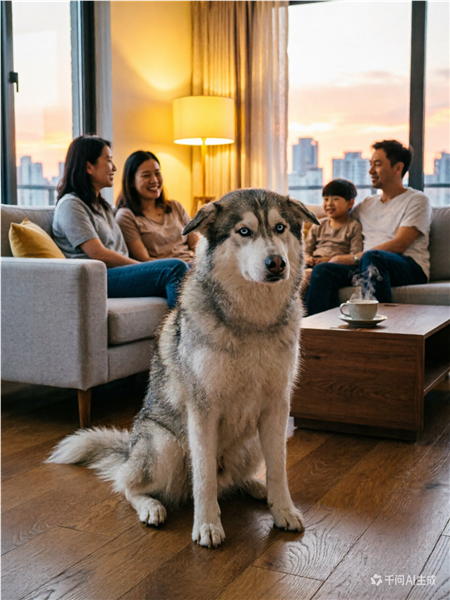
When you came to my house, you were only three months old, like a fluffy, moving cloud, with the cunning and ignorance unique to a husky. I named you "North Pole" because you have blue eyes like the polar sky. The initial joy was quickly diluted by the triviality of reality. Puppies are more energetic than you can imagine, and my life moves like a top. Work, overtime, entertainment, social... I will leave most of the time to the outside world, leaving you, often a bowl of dog food in the morning, and a tired touch after returning home late at night.
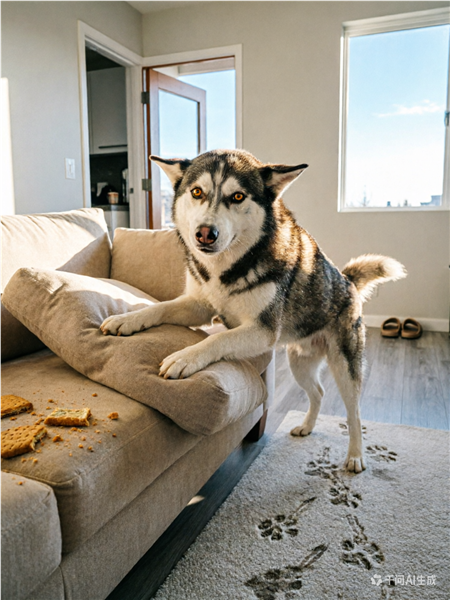
So,"home demolition" became your label. gnawed sofa legs, torn tissues, cotton scattered all over the ground... every time I come home to face a mess, my anger always comes up without explanation. I berated you, imprisoned you, and even doubted if I had made a wrong decision. Neighbors laughed and called you "Erha", and friends joked that I had raised a "demolition office director". I have also laughed bitterly, but I have never delved into what kind of thoughts you are hiding behind those bitten objects.
It was not until later that I read a lot of animal behavioral data that I understood that separation anxiety was a common problem in many dogs, especially dogs with high IQ and high social groups like huskies. Destructive behavior, excessive barking, urinating and defecating everywhere... these "problem behaviors" are often their way of expressing fear, stress and loneliness. Their world is so small that it is just us. When we leave, their clocks seem to stop, and every minute and second of waiting is infinitely stretched, full of fear of an unknown return date. Those things that are bitten, which may have our scent, are your way to try to find a trace of comfort in your loneliness. Unfortunately, back then, I only saw the destroyed property, but I didn't see your shattered sense of security.
Chapter 2: Waiting-Time behind the door and silent watch
The porch of my house is the "post" you often guard. The surveillance video recorded what you looked like when I was not at home: you rarely slept in peace, and most of the time you just lay quietly by the door with your ears upright, capturing every possible step in the corridor. The sound of the elevator and the sound of a neighbor closing the door can make you bounce up instantly and look at the crack of the door with anticipation. Then, when you realize that it's not me, the light in your eyes will dim little by little, lie down again, and repeat.
Can you play with toys? Occasionally. But more often, you just hold the toy to the door and guard it as if it were some fragile connection with me. You will stare out the window in a daze for hours, watching the clouds rolling and relaxing, watching the birds passing by, and watching the passers-by downstairs. At that moment, your world became still and became a painting called "waiting".
I once thought that giving you enough food, water, and a warm nest was fulfilling your responsibilities. I am even proud to have purchased the most expensive dog food and the most comfortable dog bed for you. But I ignored the most expensive things-time and focused companionship. You are waiting not for that dinner, but for me to come home and the person who will let you wag your tail, throw yourself into your arms, and share what you have seen throughout the day (although it is a long wait for you). Your happiness is so simple, but I am often reluctant to give it.
Chapter 3: Misunderstanding-the fiery soul under the mask of "cold and cold"
Huskies are often labeled as "independent","cold" and "letting go". Indeed, you are not as clingy as Golden Hair, and you are not as affectionate as Teddy. Sometimes you ignore my calls and focus on digging holes or chasing your own tail; when you go out for a walk, you are always like a wild horse that is out of control, full of curiosity about everything and can't even pull it. This makes me sometimes think that you may not need me that much.
What a huge misunderstanding! Later, I learned that the "independence" of huskies is a working characteristic passed down in the blood of their ancient sled dogs, and they require independent judgment. But this does not mean that they are emotionally indifferent. Instead, their emotional expressions may be deeper and more unique. After you are tired of playing, you will quietly walk to my feet and lie down, leaning your body gently against my legs; on a rainy night, even though you are trembling with fear, you will still try to get into my arms, as if each other is the only one I rely on; when I am depressed and silent, you will no longer make a fuss, just quietly put your head on my knees and touch my hand with your wet nose.
Your love is not lingering at all times, but companionship in silence, approaching in times of crisis, and silently waiting after understanding my emotions. You say you love me in your own way, but I use human and superficial standards to measure it, and almost miss the purest affection in the world.
Chapter 4: Turning Point--The epiphany in front of the sick bed
What really shook my soul was the time when you were sick. You suddenly lost appetite and disillusioned. You were taken to the hospital for examination. It was severe gastroenteritis and required hospitalization for infusion. In those days, I took leave and accompanied you in the hospital every day. You are lying on the cold diagnosis table with an indwelling needle stuck in your front paws, and your body is trembling slightly from discomfort. But whenever I approach and call your name softly, you will always try to raise your head, weakly shake your tail, and lick my hand.
At that moment, looking at your completely dependent and trusting eyes, all the walls I had built about "busyness","career", and "personal space" collapsed. This life has entrusted everything in it to me. Its happiness, its health, and its sense of security are all tied to me. And when it needed me most, was I ever absent from its daily waiting? Has it ever given only punishment when it cries for attention with destructive behavior? Guilt swallows me like a flood.
After you recovered and returned home, I began to change. I rearranged my working hours and tried to get off work on time; canceled some unnecessary social interactions; and my outdoor activities on weekends changed from climbing alone to taking you on an adventure. I found that running on the grass with you and watching you open your mouth in the wind as if you were smiling makes me happier than pushing and changing glasses at any wine table. I found that when I sat on the sofa reading, the even breathing sound of you sleeping quietly at my feet is the most healing white noise in the world.
Chapter 5: Companionship-the time we repaired together
The effect of the change is obvious. Your demolition almost disappeared. You consume excess energy because of the abundant exercise and interaction, and you are satisfied because of the inner sense of security-you know I won't be away for that long, you know that there will be interactions and games when you get home, and waiting is no longer full of anxiety. Unknowns.
We developed a lot of little rituals. Before going out in the morning, I will spend five minutes playing tug-of-war with you and tell you,"I'll be back soon"; when I get home at night, the first thing I do is put down my bag and give you a strong hug and tickle; on weekend mornings, we have breakfast together (yours is special), and then plan the day's itinerary. I learned to read your body language in more detail: leaning your ears back is not disobedient, it may be a little nervous; humming lightly is not causing trouble, it may be inviting me to play; staring at me for a long time may just be trying to confirm my existence.
This relationship is no longer a one-sided "feeding" by me, but a two-way "nourishment". You cured my anxiety and impetuosity, and used your simple happiness to remind me of the most authentic appearance of life. And I hope to become the most solid and warmest harbor in your short life.
Chapter 6: A Belated Confession-A Message to All "North Pole"
Dear Arctic, and all the hairy children like you who have been waiting foolishly:
I'm sorry. For our human self-righteousness, our busy excuses, and our fallacy of often equating material giving with love. We are always chasing the distance, but ignore the most precious waiting around us. You spend your whole life practicing a silent oath: "When you are here, I will accompany you; when you are not here, I will wait for you." However, we often let this waiting get too much loneliness.
If I could go back in time, I would like to go back to every moment when you faced an empty room alone. I want to open the door, not to frown and check what trouble you have caused, but to open my arms to welcome your happy pounce. I want to sit on the porch floor and accompany you, even if I don't do anything, just touch your head and tell you,"I'm not busy today, I'm here."
The sentence "Don't be afraid, I will accompany you" is not only a compensation for the past, but also a commitment to the future. It means: I see your emotional needs, I respect your loneliness and fear, and I choose to advance your priorities. Companion is not charity, but a gift for spending time together.
Chapter 7: For You Who Are Reading-Some Thoughts on Companion
Maybe you also have an Arctic at home, or maybe you are thinking about welcoming a furry family member. Remember:
1. Time is the currency of love. For pets, high-quality companionship trumps expensive toys and treats. Even 15-30 minutes of focused interaction (play, exercise, grooming, walking) each day can greatly increase their happiness and security.
2. Understand the needs behind the behavior. Don't get angry when your pet shows "problem behavior". Try to think like a detective about the reason behind it: Is it overenergy? Separation anxiety? Seeking attention? Or is it a health problem? Addressing the root causes will naturally improve behavior.
3. Build trust and communication. Build trust through positive training (rewarding good behavior). Learn the unique habits and body language of their species. Communication is two-way, and when you work hard to understand it, it will understand you better.
4. Accept imperfections. Just like humans, every pet has a unique personality. Accept it for what it is and love it for what it is, not for what you expect it to be.
5. Cherish the present. Their lives are much shorter than ours. Those companionship that you think has a long time to come may be half of your life for them. Don't delay love and companionship into tomorrow's regrets.
Finally, if you are with your hairy child right now, please put down your phone and look at it. If it is sleeping, touch it gently; if it is looking at you, give it a smile and a gentle word. If it is waiting for you to go home elsewhere, please try to go back early and tell it as soon as you enter the door: "I'm back. Thank you for waiting for me."
Because what they wait for is never a word of "sorry", but "together".
Arctic, thank you for teaching me how to love and accompany you with your lifelong loyalty. If you can't go back in time, then I will always be with you for the rest of the time. Don't be afraid, I will always be here.